

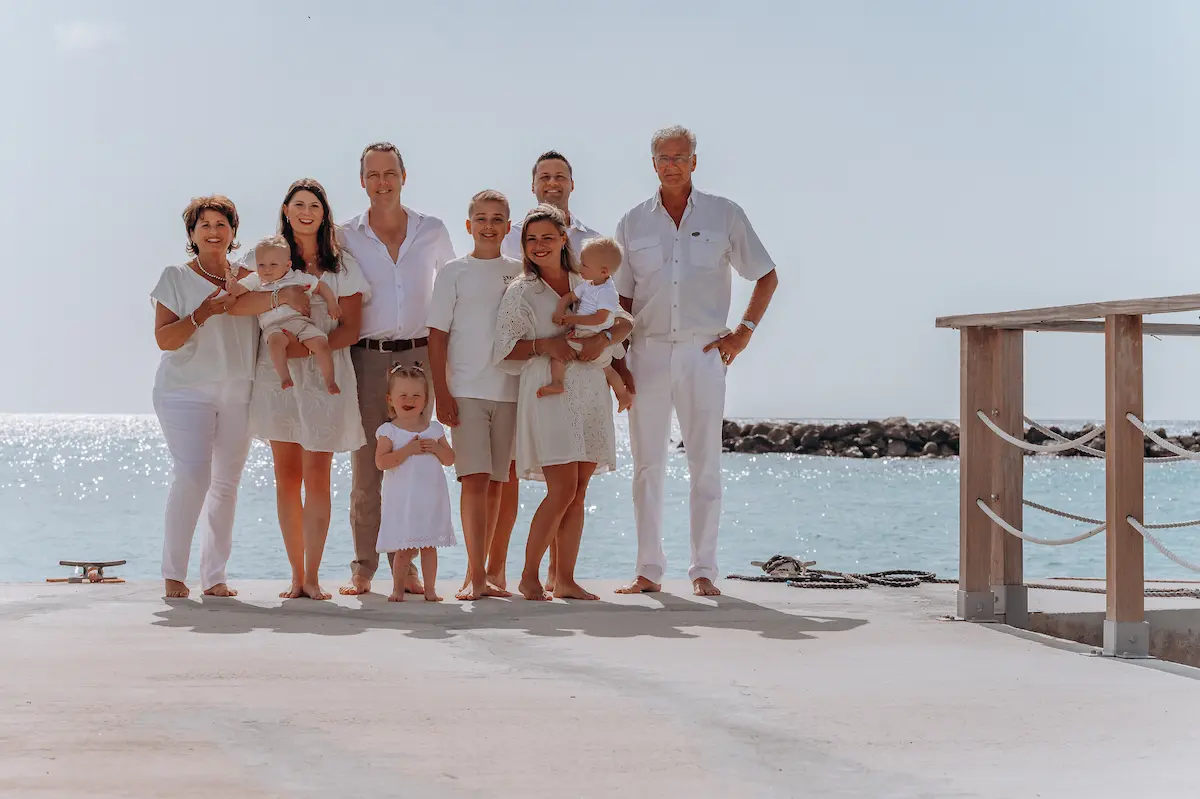
Once the shoot is planned, the same question almost always comes up: what do we wear? Clothes seem simple, but in a photo they are often the difference between a frame that is fine and one you want to keep.
You do not need a costume change. It is about choices that keep things calm, and clothes you can move in, on Curaçao, with heat, wind, and often sand. The notes below take that into account.
In short
- Earth tones and soft colors
- No large logos, no loud prints
- Comfort first, especially with children
- Layers: it is windy, and it is warm
What almost always works
For a beach photoshoot Curaçao you do not need to be a model to look good in a photo. A few steady choices do help.
Neutral colors and earth tones sit quietly in the frame. Beige, olive, rust, cream, light grey, or soft blue. Those colors work on the beach, in town, and in the green, and they do not pull attention away from faces.
Busy prints, words, and large logos are better left at home. The attention should be on you, not on a brand on a shirt. A light texture in the fabric is fine. Linen, or a fine weave, gives depth without noise.
Choose clothes that fit well, without being tight. What pinches, you keep adjusting all through the shoot, and that shows. Something a little looser is better, in a fabric that breathes. Cotton and linen beat heavy jeans or thick layers on Curaçao.
You do not all need to wear the same color. Match the mood: warm with warm, soft with soft. Two or three colors in the same family is enough. Clothes strengthen the photo when they do not take over. It is not about perfection. It is about a look that feels like you.
By situation
Family
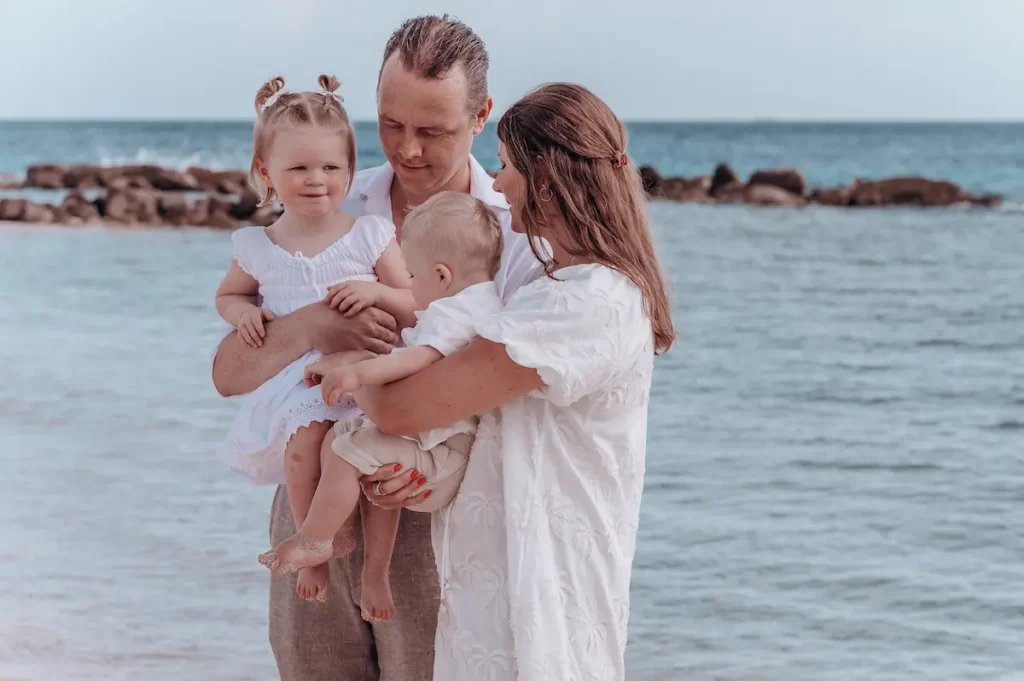
Pick two or three base colors that sit together, cream, light blue, and sand, for example. A vest, a linen shirt, or a denim jacket adds depth, without everyone in the same top. One person in bright red next to someone in white jumps out. Leave that contrast. It can be coordinated. It does not have to match perfectly.
Children
They need to run, crouch, and sit in the sand. Choose fabric that moves with them, not too tight, and preferably nothing shiny and synthetic. That reflects in the sun in a way you do not want. Softer colors work well: dusty pink, light brown, light green. A playsuit, or a dress with a denim jacket, is often stronger than something “nice” that a child will not play in. Bring a spare shirt for the little ones. Juice and the sea come with the morning.
Couple
Keep the same mood, without twin outfits. One of you in a quiet base, the other in a tone that sits with it. A hat, or a loose shirt that moves in the wind, is welcome. Large shiny belts or logos, rather not.
Town, beach, or green
Let the clothes join the place a little. Sand, stone, leaf green, and sky blue are already in the landscape. Bright pink or bright yellow often fights that. On the beach, a skirt or trousers that can take a bit of sand work well, and shoes that come off easily. Bare feet almost always look relaxed here. In town it can be a little sharper, still in a fabric that breathes.
Not sure between two outfits? Send me a photo of both beforehand. I will say honestly which one sits quieter on Curaçao, in the light and at the place we choose.
With children, one spare shirt in the bag is often enough. And if nobody at home owns the same color, that is fine too. Two or three tones in the same mood already read as one whole.
What I would put in the bag myself: an extra T-shirt, sandals that come off, and nothing you are still taking the tag off that morning.
What to leave at home
Some things are fine in daily life and work less in a photo.
Busy stripes, floral prints, or checks get noisy, especially when several people wear something loud. Shirts with text or a large logo pull the eye off the face, and they date a photo faster. Neon and bright white bounce a lot of light. You then get washed-out patches on a face or on the fabric.
Satin and a lot of polyester catch the sun hard and show every fold. Sportswear, or a real around-the-house outfit, feels comfortable, but in a photo it often looks sloppier than you think. New clothes you take the tag off that morning rarely feel like you. Wear something you already move in easily.
On Curaçao in particular: a heavy jacket for the whole shoot is too warm. A thin layer you can take on and off is smarter. White linen trousers crease. That is allowed, as long as you are not smoothing them down the whole time for the camera.
Accessories, and what to bring
Accessories are not required. If you use them, let them help.
A hat, a hairband, or a light scarf can add something on a windy coast, or give a little shade. Watch a very wide brim: it sometimes throws a shadow across the face. A blanket, or a familiar thing from home, is lovely with a family, as long as it does not become the subject of the photo.
Jewelry and glasses are fine if you wear them anyway. Large shiny pieces, leave them if you are unsure. If you do not wear glasses day to day, you do not need them now.
Shoes: sandals, or something that comes off on the beach. Heels sink in the sand. An extra T-shirt in the bag is not too much. It is warm, and sometimes there is spray.
If the weather turns
A light shower or cloud often gives soft light. In a downpour or a thunderstorm we shift the hour or the day. What you wear then depends on that new setting. You do not need a spare outfit “in case it storms.” How I handle bad weather is on a photoshoot on Curaçao in bad weather.
If you really do not know
Pick one quiet tone you feel good in: sand, cream, light blue, soft green, or warm grey. Do not buy anything special the day before. And send me two outfit photos if you want. I will look with you. Clothes should fit you, not the other way around. If you are at ease, that comes back in the photo.
The rest of the preparation, from booking to the photos at home, is on plan a photoshoot on Curaçao.
Want to book a shoot? Send the form, and we set the details without rushing.